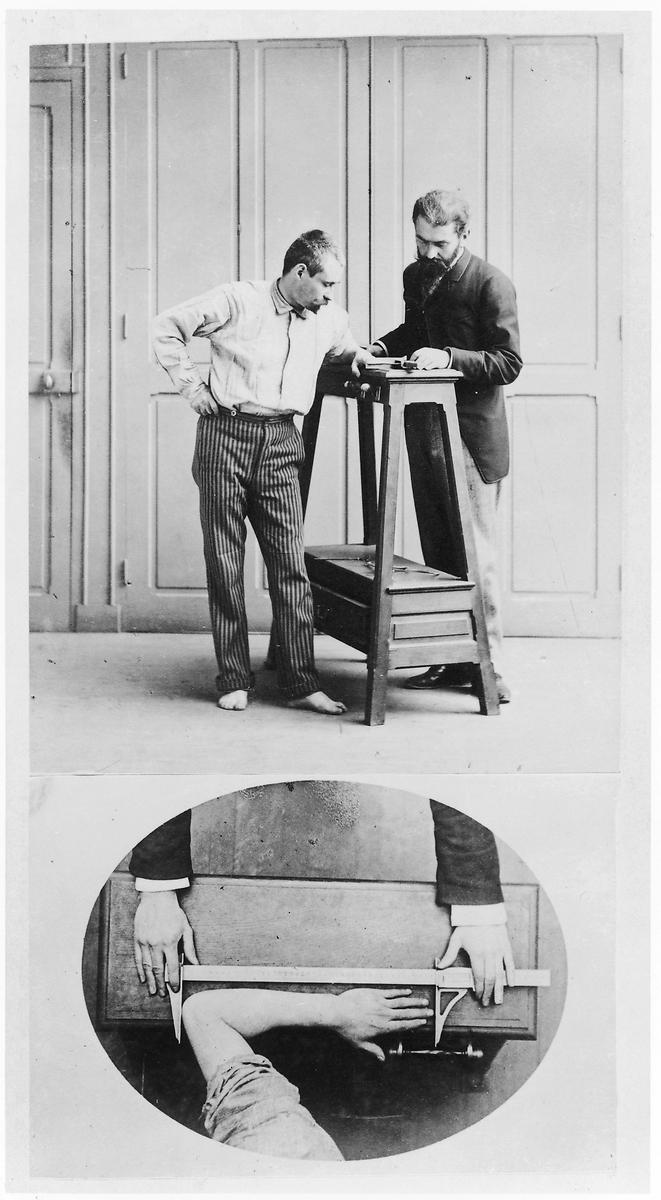
Mensuration de la coudée [Measurement of the cubit (from the tip of the middle finger to the elbow)]
Courtesy of the National Gallery of Canada, Ottawa


 Known as the “Sherlock Holmes of France” Edmond Locard was famous as a pioneer in forensic science. He pointed out that everyone leaves a trace, and even developed a 12-point method of matching fingerprints in order to identify who they belonged to. Locard and two of his assistants started the first police lab. He originally studied medicine, but became interested in solving crime after working with a criminologist, Alexandre Lacassagne.

 One of the pioneers in the field of forensic anthropology was Sara Bisel, who started using chemical and physical analysis of the skeletons found at Herculaneum, one of the cities destroyed by the eruption of Mount Vesuvius in the year 79 CE. Her methods provided insight into the health of ancient populations — and even provided a basis for the chemical analysis performed on remains today in forensic science.
 In order to better study human remains and decomposition, William Bass founded what is known as The Body Farm. This facility, the University of Tennessee Anthropological Research Facility, has been one of the most famous training grounds in forensic science. He has pioneered ways of studying human remains, and is well versed in osteology. He is a forensic anthropologist and served as an inspiration for a crime novel by Patricia Cornwell.

 Clea Koff, is well-known for her work on behalf of the United Nations. She worked for the Criminal Tribunal for Rwanda and also for the tribal for the formal Yugoslavia. She is a well-known forensic anthropologist who used her skills to help bring some of the perpetrators of genocide to trial. Her autobiography is The Bone Woman: Among the dead in Rwanda, Bosnia, and Croatia. She also founded the Missing Persons Identification Resource Center that focuses on helping families match up with the U.S. Coroner’s Office in order to identify bodies that are so for unidentified.
 Cyril Wecht is one of the most interesting forensic scientists alive today. He has consulted on a number of high profile cases, including speculation about the death of president John Kennedy. He has also shared thoughts on Vincent Foster, Anna Nicole Smith and Sharon Tate. He was also a consultant in the Branch Davidian case. He does private consultations, and was even charged with fraud at one point, though those charges were dropped. Wecht was concertmaster at the University of Pittsburgh (he wanted to be a musician), but he went on to get his M.D. and to serve as a coroner.
 Known for his work on the JonBenét Ramsey case, as well as the Laci Peterson case, Henry Lee is almost as high profile as they come. He even worked on the O.J. Simpson case, consulted on the Vincent Foster case, and was asked for insights in the D.C. sniper shootings. He was born in China, but fled with his family to Taiwan. He has a Ph.D. in biochemistry, and came to the U.S. specifically to study Forensic Science. The main blot on his career is that he is accused of evidence tampering in the Phil Spector case.
 As the host of the HBO show Autopsy, many people recognize Michael Baden.
He is also an author, writing popular non-fiction books about his work
as a coroner and board certified forensic pathologist. He contributes to
Fox News as an expert, and is a M.D. He has looked into past cases of
murder, including those of John Belushi, JFK, Czar Nicholas II
and his family, and looked into the cases of Phil Spector and O.J.
Simpson. (The overlap on such cases is common; many forensic experts
often go over the same cases — especially if the cases are famous. Baden
is a consulting pathologist with a private practice, as well as
providing expert witness testimony in court, and professional analysis
on television. For one year, he was the Chief Medical Examiner for New
York City.
As the host of the HBO show Autopsy, many people recognize Michael Baden.
He is also an author, writing popular non-fiction books about his work
as a coroner and board certified forensic pathologist. He contributes to
Fox News as an expert, and is a M.D. He has looked into past cases of
murder, including those of John Belushi, JFK, Czar Nicholas II
and his family, and looked into the cases of Phil Spector and O.J.
Simpson. (The overlap on such cases is common; many forensic experts
often go over the same cases — especially if the cases are famous. Baden
is a consulting pathologist with a private practice, as well as
providing expert witness testimony in court, and professional analysis
on television. For one year, he was the Chief Medical Examiner for New
York City.
