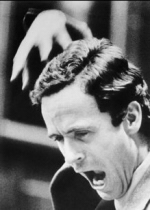
TED BUNDY
One
of the most notorious serial killers of all time, Ted Bundy was
officially linked to the murder of 36 victims, although many expert
commentators believe he probably killed at least 100 women. It is widely
acknowledged that the expert testimony by forensic odontologist
(dentist) Dr. Richard Souviron in relation to the bite mark found on
murder victim Lisa Levy; was crucial in securing the conviction and
subsequent execution of Bundy.
Click Here to read The "Most Famous Bitemark Case of the Twentieth Century" by Dr Mike Bowers.
New forensic tests have shown that bones believed to be the remains
of French icon and heroine Joan of Arc are in fact Egyptian in origin.
Forensic scientist Dr Philippe Charlier says the remains include a
charred human rib from an Egyptian mummy and the thigh bone of a cat.
Dr Charlier, from the Raymond Poincare Hospital in Garches, near Paris, obtained permission to study the relics from the France's Catholic Church last year.
He used a range of scientific tests such as spectrometry, electron microscopy, and pollen analysis.
Click Here for more details.
Joan of Arc remains 'are fakes'
The bones came from a mummy, Philippe Charlier says
Bones thought to be the holy remains of 15th Century French heroine Joan of Arc were in fact made from an Egyptian mummy and a cat, research has revealed.
In 1867, a jar was found in a Paris pharmacy attic, along with a label claiming it held relics of Joan's body.
But new forensic tests suggest that the remains date from between the third and sixth centuries BC - hundreds of years before Joan was even born.
The study has been reported in the news pages of the Nature journal.
Forensic scientist Dr Philippe Charlier, who led the investigation, told Nature: "I'd never have thought that it could be from a mummy."
Read More
The Dr. Sam Sheppard Murder Case
The death of Marilyn Sheppard in 1954 remains one of the most infamous unsolved murders in the USA. The subsequent arrest of her husband, Dr. Sam Sheppard resulted in what became known as the "Trial of the Century" in 1954 followed by the "Re-Trial of the Century" in 1966.
In 1999 the TV science series NOVA aired a program on the Sheppard case which re-examined the forensic evidence surrounding the case. Nova also produced an excellent supporting website entitled "The Killer's Trail".
A riveting, step-by-step account of the key events in the Sheppard murder case, assembled by Sheppard's son and attorney-journalist Cynthia Cooper.
Click Here to visit the website.
Read More
Forensic science is a fascinating topic in its own right but when its employed, discussed and debated in relation to celebrities, high profile trials and key historical figures it becomes utterly compelling.
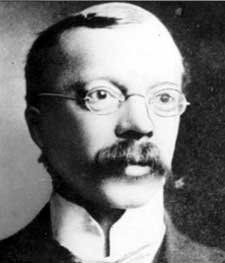
Dr Hawley Harvey Crippen
Forensic science is shedding new light on one of the most notorious murder cases in British history. In 1910 American born Dr Hawley Harvey Crippen was found guilty and subsequently hanged for the murder of his wife Cora. Crippen is said to have poisoned Cora, dismembered her body and then buried her remains in the cellar of their London home.
However, in a remarkable twist to a case that has spawned intrigue and interest for almost a century a team of forensic scientists from Michigan State University believes that modern forensic science proves that the remains buried in Crippen’s cellar could not be those of his wife.
The forensic team behind this amazing finding was David Foran, a forensic biologist and director of MSU’s forensic science program, forensic toxicologist John Harris Trestrail and genealogist Beth Wills. The basis for their claim arose from DNA analysis conducted on a microscope slide sample that was presented as evidence during Crippen's trial. During the trial forensic pathologist Bernard Spilsbury testified that the sample revealed an abdominal scar consistent with Cora Crippen's medical history, testimony that helped convince the jury that the remains were those of Cora.
The simple premiss underpinning extremely complex forensic DNA analysis is that if Dr Hawley Harvey Crippen murdered his wife and disposed of remains, then those remains would share specific DNA characteristics with Cora Crippen’s living relatives. However, they do not! As David Foran notes "We took a lot of precautions when doing this testing...We just didn’t stop. We went back and started from scratch and tested it again. The DNA in the sample is different from the known relatives of Cora Crippen."
Which of course begs the question, whose remains were buried in the cellar?
Read More